

In 2026, choosing a crypto wallet is no longer just about storing tokens. Users now want one place to manage assets, connect to dApps, trade across chains, discover onchain opportunities, and stay safer while navigating Web3. That is why more people are searching for terms like What is OKX Wallet, Is OKX Wallet safe, OKX Wallet Chrome extension, OKX Wallet vs MetaMask, and best crypto wallet for beginners. OKX Wallet is increasingly part of that conversation because it combines self-custody, multichain access, built-in Web3 tools, and reward-focused features such as Boost and X Launch.
Start with OKX Wallet and explore Web3, multichain access, and Boost opportunities
What is OKX Wallet?
OKX Wallet is a self-custody, multichain Web3 wallet built for users who want to store crypto, connect to decentralized apps, swap assets, manage NFTs, and access Web3 tools from one place. On its official download page, OKX describes the wallet as a multichain wallet for the decentralized world across 130+ blockchains, including Ethereum and Solana, while the main OKX Wallet page presents it as a gateway to dApps, staking, swapping, and onchain activity.
That matters because many people still confuse exchange accounts with Web3 wallets. An exchange account is custodial. A self-custody wallet is different: the user holds the keys and controls access. OKX’s Web3 FAQ states that OKX Wallet is non-custodial, that private keys and seed phrases are stored locally on the user’s device, and that OKX cannot access, reset, or recover them.

Why are more people searching for OKX Wallet in 2026?
The short answer is product depth. OKX Wallet is not presented as a basic send-and-receive wallet. Its official pages emphasize multichain asset management, dApp discovery, DeFi, NFTs, DEX routing, and Boost-based rewards. Its DEX FAQ says the OKX DEX aggregator compares prices and paths across 100+ DEXs and supports 100,000+ tokens across 10+ chains, which makes the wallet more attractive to users who want active Web3 participation rather than passive storage alone.
Another reason is the rewards layer. OKX’s Boost guide explains that users can trade on OKX DEX, build eligibility through trading activity and balances, and participate in reward paths such as X Launch, giveaways, and trading competitions. This helps explain why users searching for a Web3 wallet also search for airdrop opportunities, early access projects, and OKX Boost rewards.
OKX Wallet extension: Chrome, Opera, and Firefox
One of the most searched topics around OKX Wallet is the browser extension. OKX’s official learning guide says the OKX Wallet extension is available for Chrome and other Chromium-based browsers, while the official download page highlights Safari & Chrome extension support. The Chrome Web Store also lists the official OKX Wallet extension as a self-custodial Web3 wallet available across app, web, and extension experiences.
That leads to an important practical question: Does OKX Wallet work in Opera? Opera’s own extension documentation states that Opera is based on Chromium and can run Chrome extension packages. That means Opera users can generally use Chrome-compatible extensions, which is why OKX Wallet can make sense for Opera users as well when installed through the Chrome-extension route supported by Chromium-based browsers.

What about Mozilla Firefox? Here the answer is more cautious. I did not find an official OKX Wallet Firefox extension listing on OKX’s official download or support pages. OKX’s own materials consistently point to Chrome/Chromium browsers, Safari, and the mobile apps. Because of that, it is safer to say that OKX does not currently present a Firefox extension as an official supported option on its main wallet pages. Users should avoid unofficial add-ons that claim to be OKX Wallet for Firefox unless OKX itself publishes an official listing.
Is OKX Wallet a Web3 wallet?
Yes, and this is one of the core reasons it stands out. OKX repeatedly positions the product as an OKX Web3 Wallet and a gateway to crypto and Web3. The platform highlights use cases across DeFi, NFTs, GameFi, dApps, token trading, and multichain management. It is designed not only to hold assets, but to act as an interface for broader onchain activity.
This is also why the wallet appeals to beginners and advanced users differently. Beginners may like that the wallet pulls several Web3 functions into one interface. More advanced users may care more about routing, dApp access, cross-chain activity, and onchain opportunity discovery. Either way, OKX Wallet is clearly built as a Web3 operating layer, not just a static wallet app.
Is OKX Wallet safe?
This is one of the biggest search questions, and the most honest answer is: it is designed with strong security features, but it is still a self-custody wallet, so user behavior matters enormously. OKX’s official pages say the wallet is self-custodial, that only the user holds the private keys, and that private keys and seed phrases are stored locally on the device. The platform also says it uses encryption and highlights wallet-security resources, support content, and security pages.
OKX’s learning guide adds that the wallet uses encryption, offline key generation, and third-party audits, and says it offers real-time alerts when users interact with suspicious dApps or risky transactions. Even if some of those details appear in OKX-authored learning content rather than core product copy, the broader security message is consistent: the wallet is built for self-custody, but losing your seed phrase or private key can permanently lock you out, because OKX cannot recover them for you.
How do you create or import an OKX Wallet?
This is another high-intent search topic. OKX’s support pages explain that users can create a wallet from the extension or app, set a password, and back up the seed phrase. If users already have a wallet, they can import it using a seed phrase, private key, or in some cases a hardware wallet. On mobile, OKX also documents options such as cloud backup and keyless wallet restoration, depending on the setup path.
The key point for SEO and user trust is simple: OKX Wallet supports both create and import flows, and the seed phrase remains the critical recovery layer. If you lose the password but still have the seed phrase or private key, you can reinstall and recover. If you lose the seed phrase/private key, access may be lost permanently.
OKX Wallet vs MetaMask: which is better in 2026?
This is probably the single most commercial search comparison in this niche. The fair answer is not that one wallet is objectively perfect for everyone, but that they are optimized differently.
MetaMask remains one of the best-known self-custody wallets in crypto. At the same time, OKX Wallet’s official positioning is broader and more all-in-one: multichain access, dApp discovery, DEX routing, Web3 participation, and Boost rewards are all part of the same ecosystem. OKX’s own comparison table claims broader multichain support, built-in staking, cross-chain swaps/bridges, audits, NFT support, and 24/7 live chat relative to several competitors including MetaMask. That table is OKX-authored and should be treated as vendor comparison content, but it still reflects how OKX wants the wallet to compete.
In practical terms, many users may prefer OKX Wallet over MetaMask for three reasons. First, the product is more explicitly designed around discovery and activity, not only wallet connection and signing. Second, the wallet is tightly connected to OKX DEX, Boost, and X Launch, which makes it more attractive for users chasing early onchain opportunities. Third, its official browser and mobile onboarding materials present a more guided experience for users who want Web3 tools in one place. That does not make MetaMask irrelevant; it means OKX Wallet may be the better fit for users who want a more integrated Web3 workflow.
Is OKX Wallet good for beginners?
Yes, for many beginners it can be. The reason is not just the wallet UI. It is the fact that the wallet sits inside a broader Web3 system: dApps, routing, multichain assets, rewards, and guided support content all live nearby. For someone new to Web3, that can feel less fragmented than piecing together multiple tools from scratch. OKX’s official materials also document wallet creation, importing, backups, and web/mobile setup clearly, which helps reduce first-use friction.
That said, “beginner-friendly” does not mean “risk-free.” It still requires seed-phrase discipline, phishing awareness, and careful transaction signing. A wallet can make Web3 easier to access, but it cannot remove the responsibility that comes with self-custody.
What is OKX Boost and why does it matter?
Boost is one of the most important reasons OKX Wallet gets attention beyond ordinary wallet keywords. OKX describes Boost as a way to connect DEX trading activity with potential rewards from emerging projects. The Boost explainer says users can trade on OKX DEX, build Boost metrics, join reward programs, and claim allocations or rewards through paths such as X Launch, giveaways, and competitions.
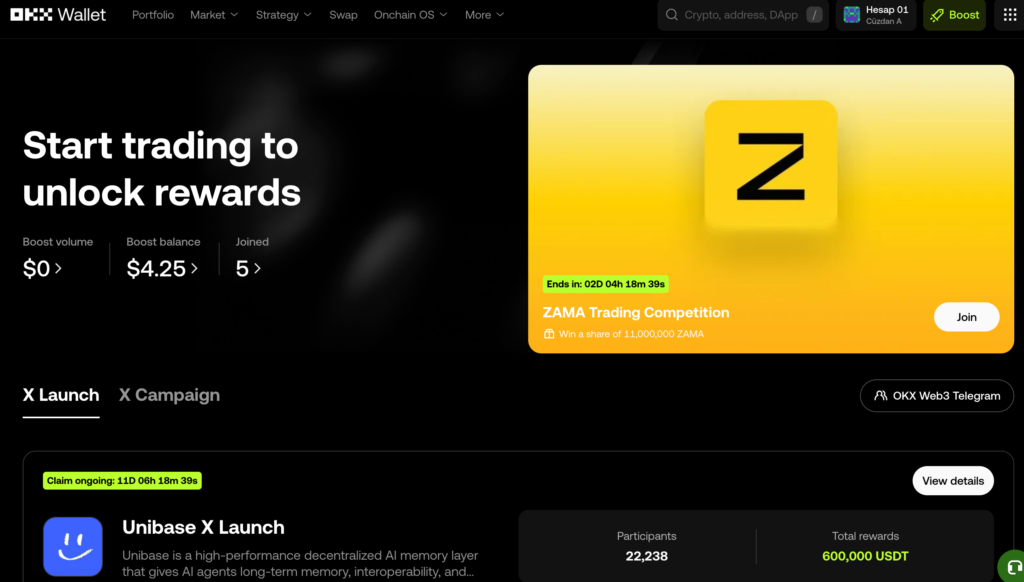
This matters for SEO because many users are not just searching for “wallet.” They are searching for airdrop wallets, best wallet for Web3 rewards, early project access, and how to get crypto rewards with a wallet. OKX Wallet is positioned to capture that demand because the wallet is linked directly to Boost participation.
What is X Launch on OKX Wallet?
X Launch is part of the Boost system and is positioned as a gateway to emerging projects. OKX’s Boost guide says X Launch gives eligible users access to selected projects and potential shares of reward pools based on DEX trading activity and other activity-based criteria. In short, X Launch is one of the mechanisms through which OKX turns wallet activity and DEX use into early-access and reward opportunities.
For users interested in new tokens, reward pools, and project discovery, this is a major differentiator. It turns the wallet into more than storage software; it becomes a practical entry point to onchain campaigns and project participation.
Does the sign-up path matter?
For users who want to start with the same Web3 entry point referenced in this guide, yes, the sign-up path can matter in a practical sense. OKX’s referral FAQ shows that referral binding can be device-level, and that commissions are calculated based on the device used for trading. That means link/device routing is not purely cosmetic; it can affect how referral attribution works.
In plain English, the cleanest way to present this in an article is not to make unrealistic promises. It is simply to say that readers who want to start from the intended Web3 route used in the guide can do so, and that using the intended path may help keep setup and attribution cleaner. That is accurate, subtle, and much better for trust than overselling it.
Final verdict
If your goal in 2026 is to find a self-custody Web3 wallet that does more than just hold assets, OKX Wallet is one of the strongest options to consider. Officially, it offers multichain support across 130+ blockchains, self-custody key control, browser/mobile access, dApp connectivity, DEX aggregation, and a rewards layer through Boost and X Launch. Chrome and Chromium-based browser users are directly supported, Opera users can generally benefit from Chromium compatibility, and Firefox users should be cautious because OKX does not prominently present an official Firefox extension on its main wallet pages.
For SEO and user intent, the strongest positioning is this: OKX Wallet is not only a wallet, but a Web3 access layer. That is why it can rank for queries around wallets, browser extensions, multichain tools, Web3 access, MetaMask alternatives, beginner wallets, and onchain rewards—all at once.