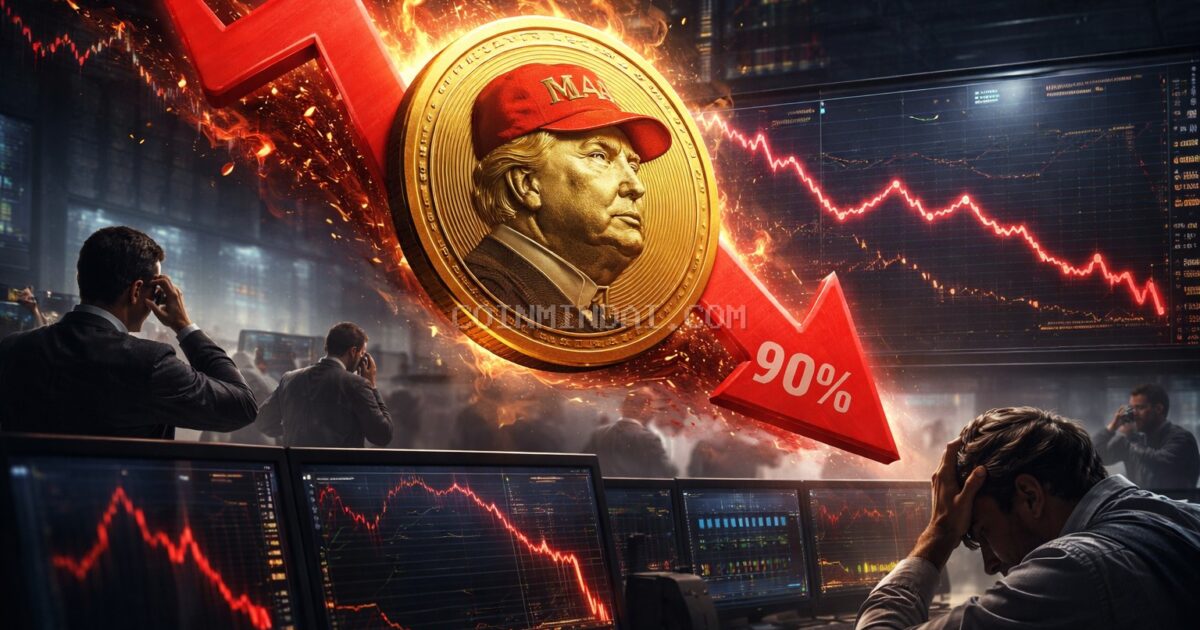
Two of the most politically charged crypto projects in the United States are now trading near record lows, and the fallout is rippling across both Washington and the broader decentralized finance ecosystem. The Official Trump memecoin (TRUMP) has collapsed roughly 90% from its January 2025 all-time high above $73, with CoinGecko data showing the token trading near $2.86 after touching an all-time low of approximately $2.73 in March 2026. The supporting evidence appears in the cited X post.
World Liberty Financial (WLFI), the DeFi platform co-founded by Trump’s sons, saw its governance token sink to a fresh all-time low of $0.07 over the weekend, down nearly 75% from its September 2025 peak of around $0.31, according to CoinMarketCap data. The dual collapse has accelerated scrutiny from Democratic lawmakers and reignited a broader debate about whether politically branded crypto projects distort market integrity.
Token Crashes Collide With Political Access Controversy
President Trump recently announced a second gala for TRUMP token holders, scheduled for April 25, requiring attendees to hold the memecoin as a condition of entry.
Senators Elizabeth Warren, Richard Blumenthal, and Adam Schiff sent a letter to Bill Zanker, the individual who launched the TRUMP memecoin, demanding details about the event’s purpose and structure.
The senators described the organizers as “dangling access” to Trump in exchange for token purchases, a characterization that Politico reported after obtaining a copy of the correspondence.
Trump and his family are positioned to benefit financially from increased TRUMP token demand driven by the gala, the lawmakers argued. The event structure effectively ties political access to speculative asset purchases, a dynamic critics say crosses clear ethical lines.
What These Crashes Reveal About DeFi Credibility
The WLFI implosion carries specific weight for the DeFi sector because the token was framed as a governance instrument for a legitimate decentralized finance protocol, not merely a speculative memecoin.
When governance tokens lose 75% of their value within months of launch, it undermines the broader narrative that DeFi platforms can attract durable, mission-aligned stakeholders rather than short-term speculators.
Celebrity and politically affiliated token launches have historically generated explosive early volume followed by steep long-term declines, a pattern that Layer 2 infrastructure builders and serious DeFi developers have warned distorts retail perception of the entire asset class.
WLFI’s trajectory reinforces that warning with hard numbers. The damage is not only financial: it pushes institutional DeFi adoption further back by associating the space with influence-peddling optics.
Academic Voices and Industry Reaction
Professor Tonya Evans, a legal scholar and crypto educator widely cited in policy discussions, offered a sharp assessment of the token collapses. In a post shared on X, Evans drew a direct comparison to previous industry scandals, saying, “We thought Sam Bankman-Fried or Gary Gensler were the worst things to happen to the crypto industry, and they were horrible.”
Her comment signals how deeply the Trump token situation has penetrated professional crypto discourse, extending well beyond partisan politics into questions of market structure and regulatory legitimacy.
The reference to Bankman-Fried is pointed: FTX’s collapse in late 2022 triggered a prolonged institutional confidence crisis that took years to partially recover from. A similar confidence drain, this time tied to an active sitting president, carries its own systemic risks.
What Global Crypto Investors Are Watching Now
For investors outside the United States, the Trump token saga arrives against a backdrop of intensifying global crypto regulation and a macro environment defined by persistent trade policy uncertainty and cautious Federal Reserve positioning on rate cuts.
Regulatory bodies in the European Union and Asia have repeatedly cited U.S. political crypto activity as evidence that stronger disclosure rules are necessary.
Retail investors who entered TRUMP or WLFI near their peaks are sitting on severe losses with limited legal recourse, given the current absence of memecoin-specific investor protection frameworks in U.S. law.
The episode highlights a structural gap: politically connected token launches can generate enormous hype without meeting any of the disclosure standards applied to traditional securities. For global investors, that gap is a risk factor, not a loophole.
The Road Ahead for Political Crypto Projects
The April 25 gala will likely become a focal point for further Congressional action, with Warren’s office already signaling interest in legislation targeting token-gated political access events.
Whether that translates into enforceable rules before the next election cycle remains uncertain, but the legislative pressure is building faster than many in the industry expected.
For the broader crypto market, the more lasting consequence may be reputational. Projects building real DeFi infrastructure, scaling Layer 2 networks, or developing compliant tokenized assets now face a public perception burden amplified by high-profile failures tied to political celebrity.
The TRUMP and WLFI collapses did not break the market, but they handed critics a durable argument that the industry has not fully resolved its governance and ethics problems. How founders and protocols respond to that argument in the months ahead will matter as much as any price recovery.
Not Financial Advice: This article is for informational purposes only. Crypto investments are highly volatile. Always do your own research.