

Did you know that over $5.6 billion worth of cryptocurrency was lost to scams and fraud in 2023 alone, according to the FBI’s Internet Crime Report? And a significant chunk of those losses came not from sophisticated hacks but from people who simply didn’t know the basics of buying and storing Bitcoin safely.
The process of buying Bitcoin has never been more straightforward. But “straightforward” doesn’t mean “risk free.” There’s a right way to do it and a very expensive wrong way. This guide focuses entirely on the right way.
Whether you want to put in $50 or $50,000, the steps are exactly the same and we’re going to walk through every single one of them.
What You Need Before You Buy Bitcoin
Let’s say your name is Michael. Michael heard about Bitcoin from a colleague, did a bit of research, and decided he wants to buy some. He goes to Google, types “buy bitcoin fast,” clicks the first result and ends up on a page that looks exactly like a real exchange but isn’t.
Michael loses $800 in under three minutes.
This isn’t rare. It happens every single day. The good news? It’s entirely preventable. Before you touch any exchange, make sure you have these three things ready:
- A verified government-issued ID Every legitimate, regulated exchange requires identity verification (KYC). This protects you as much as them.
- A payment method Bank transfer, debit card, or credit card. We’ll explain which one to use when.
- A dedicated email address with a strong password Don’t use your everyday email. Create one specifically for crypto. This limits the blast radius if anything goes wrong.
That’s it. You don’t need to understand blockchain at a deep technical level to make your first purchase. But understanding what Bitcoin actually is will help you make smarter decisions along the way.
Step 1: Choose a Bitcoin Exchange And Don’t Rush This Part
An exchange is the platform where you buy and sell Bitcoin. Think of it like a currency exchange desk at an airport except it operates 24/7 and handles over $80 trillion in annual volume
This is the single most important decision you’ll make as a new buyer. In countries like Turkey, India, and South Korea, users have lost billions of dollars to exchanges that suddenly shut down, froze withdrawals, or turned out to be fraudulent from the start. The exchange you choose matters more than the price you pay.
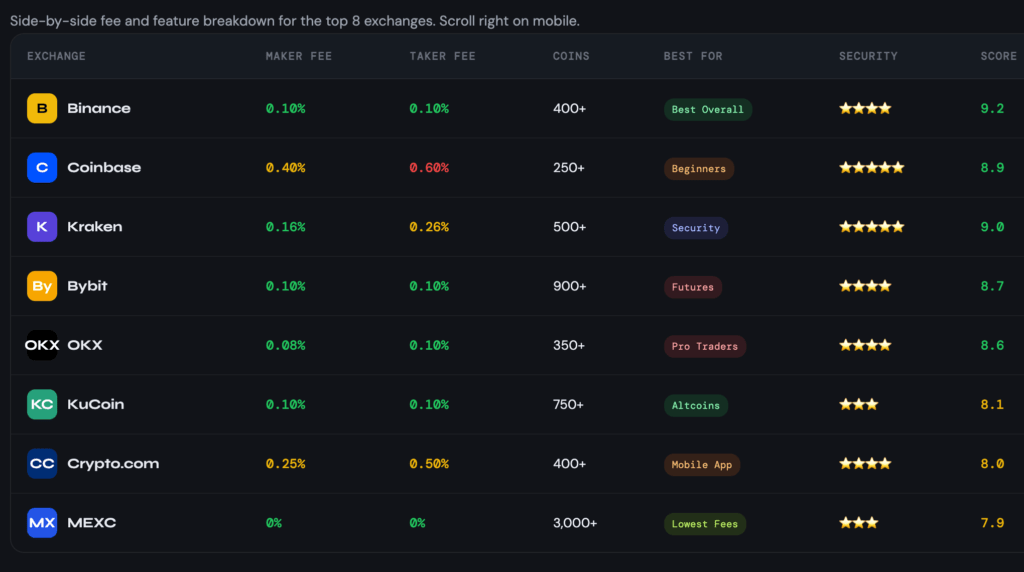
What Actually Makes an Exchange Trustworthy?
Regulation and licensing — Is the exchange registered with financial authorities in your country? In the US, look for FinCEN registration and state-level licensing. In the EU, MiCA-compliant platforms. Regulated exchanges are legally required to hold your funds properly and maintain security standards. Unregulated ones are not.
Security track record — Has the exchange ever been hacked? How did they respond? An exchange that was hacked, compensated users fully, and overhauled its security is often more trustworthy than one that’s never been tested. Look for platforms with cold storage (funds kept offline), multi-signature wallets, and independent security audits.
Fee structure — Here’s something most guides gloss over: a 3.99% card fee on a $1,000 purchase means you’re starting $40 in the hole. Fees compound quickly. Most serious exchanges charge between 0.1% and 0.5% for standard trades. Instant-buy features charge more — sometimes much more.
Liquidity and volume — A low-volume exchange means you might struggle to buy or sell at the price you see. Stick to platforms with consistently high trading volume.
Well-Known Exchanges to Consider
| Exchange | Best For | Approximate Trading Fee |
|---|---|---|
| Coinbase | US-based beginners | 0.5% – 1.5% (instant buy) / ~0.6% (Advanced) |
| Binance | Global users, active traders | 0.1% standard (discounts available) |
| Kraken | Security-focused buyers | 0.25% maker / 0.40% taker |
| Gemini | US buyers, institutional | 0.2% – 0.4% (ActiveTrader) |
| Bybit | Advanced traders | 0.1% maker / 0.1% taker |
💡 CoinMindAI Tip: Always verify you’re on the official website before entering any information. Bookmark the real URL after your first visit. Phishing sites impersonating exchanges are among the most common crypto scams in 2026. You can compare exchanges in detail on our Best Crypto Exchanges guide.
Step 2: Create Your Account The Right Way
Registration on a major exchange typically takes 10 to 20 minutes. Most people rush through this step. Don’t.
Use the official website directly — Never click an exchange link from an email, social media post, or search ad. Type the URL manually or use a saved bookmark.
Set up two-factor authentication before you do anything else — 2FA is an extra verification step required every time you log in. Use an authenticator app — Google Authenticator or Authy — rather than SMS. Here’s why: in 2019, a group of attackers in the US convinced phone carriers to transfer victims’ phone numbers to new SIM cards they controlled. Once they had the SMS codes, they drained accounts containing millions of dollars. An authenticator app can’t be SIM-swapped.
Complete identity verification fully — Upload your ID, complete the selfie check, and verify your address if required. This typically unlocks higher deposit and withdrawal limits and provides you with legal protections if something goes wrong.
Set up a withdrawal whitelist — Most exchanges allow you to restrict withdrawals to a pre-approved list of wallet addresses. Enable this. It means that even if someone gains access to your account, they can’t send your funds to an unknown address without an additional email confirmation from you.
⚠️ Important: No legitimate exchange employee will ever contact you first and ask for your password, seed phrase, or 2FA code. Ever. If someone claiming to be from support asks for any of this, it is a scam — full stop.
Step 3: Deposit Funds — Know Your Options
Once your account is verified, you can deposit the currency you’ll use to buy Bitcoin. Your options and their trade-offs:
Bank Transfer (ACH / SEPA / Wire)
The most cost-effective method for most buyers. Fees are typically very low or zero, depending on the exchange and your bank. The downside is speed ACH transfers in the US take 1–3 business days; SEPA in Europe takes 1–2 days; wire transfers are faster but often have minimum amounts.
Best for: Larger purchases where you can afford to wait a few days.
Debit or Credit Card
Fast often instant or within minutes. But you pay for that speed. Card fees on exchanges typically range from 1.5% to 3.99% per transaction. Some banks also block cryptocurrency purchases on credit cards outright, or treat them as cash advances with additional fees on the bank side. Check your card’s terms before trying.
Best for: Smaller first purchases where you want to get started quickly and learn the process.
PayPal, Apple Pay, Google Pay
Available on select platforms. Convenient, but fees are on the higher end. Access to your Bitcoin is sometimes restricted for a period after purchase on certain platforms.
Best for: Very small amounts to get a feel for the process.
💡 For a first purchase of $200 or more, a bank transfer almost always wins on total cost. Do the math before you deposit.
Step 4: Buy Bitcoin And Understand What You’re Buying
Here’s where most people freeze up. The interface can look intimidating. It doesn’t need to be.
Market Order: The Simple Option
A market order buys Bitcoin immediately at the current market price. You type in how much you want to spend, confirm, and the transaction happens in seconds. Simple and clean.
The one risk: in a fast-moving market, the price between when you click “buy” and when the order actually fills can differ slightly. This is called slippage. For small amounts, it’s negligible.
Best for: First-time buyers, small amounts, anyone who wants to get started now.
Limit Order: The Patient Option
A limit order lets you name your price. You tell the exchange: “I’ll buy Bitcoin, but only if the price drops to $X.” Your order sits in the system and executes only when that price is reached — or expires if it never gets there.
Best for: Buyers who have been watching the market and have a target price in mind.
Dollar Cost Averaging: The Smartest Option for Most People
Here’s a question: Is now a good time to buy Bitcoin?
Honest answer? Nobody knows. Not analysts, not traders, not the people on social media confidently declaring “this is the bottom.” Multiple academic studies on retail investing show that most people who try to time the market end up buying near peaks and selling near bottoms the exact opposite of what they intended.
Dollar-cost averaging (DCA) sidesteps this entirely. You invest a fixed amount say, $100 on a regular schedule regardless of price. When Bitcoin is expensive, your $100 buys less of it. When it’s cheap, your $100 buys more. Over time, your average purchase price smooths out.
Most major exchanges offer automated recurring purchases. Set it, forget it, and stop watching the price every hour.
Best for: Anyone investing for the long term who doesn’t want to lose sleep over daily price swings.
📊 Before you buy, check the mood of the market: Our Crypto Fear and Greed Index gives you a live reading of whether the market is in panic or euphoria mode. Buying when others are fearful has historically been one of the better entry strategies — though nothing in crypto is guaranteed.
How Much Bitcoin Should You Buy?
One of the most common misconceptions among new buyers: they think they have to buy a whole Bitcoin. You don’t. Bitcoin is divisible to eight decimal places. The smallest unit 0.00000001 BTC is called a satoshi. At current prices, you can buy $10 worth of Bitcoin with no problem at all.
Most first-time buyers start with somewhere between $50 and $500. Enough to learn the process and feel the market, not so much that a bad week ruins your month.
Step 5: Secure Your Bitcoin The Step Most People Skip
Let’s go back to Michael.
Michael bought his Bitcoin. It’s sitting in his exchange account. He checks the price twice a day. He’s feeling good.
Then the exchange announces it’s experiencing “technical difficulties.” Withdrawals are paused. A week later, the company files for bankruptcy.
Michael’s Bitcoin is gone.
This isn’t a hypothetical. FTX, one of the largest crypto exchanges in the world, collapsed in November 2022. Billions of dollars belonging to customers evaporated overnight. The CEO ended up in prison, but the customers didn’t get their money back for years and many never did fully.
The crypto industry has a saying that explains this perfectly: “Not your keys, not your coins.”
When your Bitcoin sits on an exchange, you don’t actually own it in the way you think. The exchange holds it. You hold an IOU. If the exchange fails, gets hacked, gets sanctioned, or simply decides to freeze your account, your access to those funds can disappear.
The solution is to move your Bitcoin into a wallet you control.
Understanding Wallets
Custodial wallets (exchange accounts): The exchange holds your private keys. Convenient for trading. Risky for long-term storage.
Non-custodial wallets (you hold the keys): You are responsible for your own security. No third party can freeze, seize, or lose your funds but also no one can rescue you if you lose access.
Types of Non-Custodial Wallets
Hardware wallets the gold standard
A hardware wallet is a small physical device about the size of a USB drive that stores your private keys completely offline. Even if your computer is infected with malware, your Bitcoin remains safe because the keys never touch the internet.
Leading options in 2026:
- Ledger (Nano X, Nano S Plus) — Widely used, Bluetooth-enabled, broad coin support
- Trezor (Model T, Safe 3) — Open-source firmware, strong community trust
- Coldcard — Bitcoin-only, favored by security-focused users
If you’re holding more than a few hundred dollars worth of Bitcoin for the long term, a hardware wallet is not optional — it’s essential.
Software wallets balanced convenience
Software wallets live on your phone or computer. They’re connected to the internet, which makes them more vulnerable than hardware wallets. But they’re significantly more secure than leaving funds on an exchange.
Popular options:
- BlueWallet — Bitcoin-only, mobile, open-source
- Trust Wallet — Multi-coin, mobile, non-custodial
- Electrum — Desktop, Bitcoin-only, feature-rich for advanced users
For small amounts you plan to spend or trade, a software wallet is perfectly reasonable. For long-term holdings, pair it with a hardware wallet.
The Seed Phrase: The Most Important Thing You’ll Ever Write Down
When you set up any non-custodial wallet, you’ll be given a seed phrase typically 12 or 24 random words in a specific order. This is the master key to your entire wallet. Anyone who has these words can access and drain every cent you own in that wallet, from anywhere in the world, at any time.
Rules for your seed phrase no exceptions:
- Write it on paper. Immediately. Do not photograph it, type it into any app, store it in your email drafts, or save it to cloud storage.
- Store your written copy in at least two separate physical locations.
- Consider a fireproof safe or a metal backup plate (stainless steel or titanium) for long-term storage.
- Never share it with anyone. Not support agents. Not family members. Not us. Nobody.
People who lose their seed phrase lose their Bitcoin. There is no recovery. There is no customer service number. This is the hardest part of cryptocurrency and the most important.
Step 6: Transfer Your Bitcoin Off the Exchange
Once your wallet is set up and your seed phrase is safely stored, it’s time to move your Bitcoin.
- Open your wallet app and find your receiving address — a long string of letters and numbers, or a QR code.
- In your exchange account, navigate to Withdraw → Bitcoin.
- Paste your receiving address. Do not type it manually — copy-paste is mandatory.
- Send a test transaction first. Before moving your full balance, send a small amount $5 worth and confirm it arrives. A few dollars is cheap insurance.
- Verify the first and last 6 characters of the address before confirming. There is malware that silently replaces clipboard contents with an attacker’s address when you paste. Always verify.
- Confirm and wait. Bitcoin transactions typically take 10 to 60 minutes to confirm on the network.
⚠️ Bitcoin transactions cannot be reversed. If you send to the wrong address whether due to a typo, malware, or any other reason the funds are permanently gone. There is no undo button, no dispute process, and no recovery. Verify. Verify again. Then confirm.
The Mistakes That Cost People the Most Money
Buying on FOMO — When Bitcoin is all over the news and everyone’s talking about it, that’s usually when it’s most expensive. Prices driven by hype tend to correct sharply. Check our Fear and Greed Index before any purchase if the index reads “Extreme Greed,” that’s historically a signal to proceed carefully rather than rush in.
Ignoring fees — A 3.99% card fee on a $2,000 purchase costs you $80 upfront. That’s not including spread markups on instant-buy features. Calculate your total cost before every transaction.
Leaving significant amounts on exchanges — For active traders moving in and out of positions, exchange storage is fine. For anyone holding Bitcoin as a long-term investment, it is not.
Sharing your seed phrase — We’ll say it again because it bears repeating: no legitimate entity will ever ask for your seed phrase. If someone asks, it is a scam.
Using public Wi-Fi — Never access your exchange account or wallet on an unsecured network. If you must, use a reputable VPN.
Trusting “guaranteed return” offers — There is no guaranteed return on any investment, anywhere. Anyone promising one — regardless of how professional they look or how many followers they have is running a scam.
Bitcoin and Taxes: What You Need to Know
Tax treatment of Bitcoin varies significantly by country, but in most major jurisdictions:
- Buying Bitcoin is not a taxable event.
- Selling Bitcoin for fiat currency is a taxable event capital gains or losses apply.
- Trading Bitcoin for another cryptocurrency is also typically taxable.
- Receiving Bitcoin as payment is usually treated as ordinary income at the fair market value on the day you received it.
Keep a detailed record of every transaction: the date, the amount, the price at the time of purchase, and the price at the time of sale. Dedicated crypto tax tools — Koinly, CoinTracker, TaxBit — can pull this data automatically from major exchanges via API.
Always consult a qualified tax professional in your jurisdiction before filing. This is general information, not tax advice.
Frequently Asked Questions
How much does it cost to buy Bitcoin?
You can buy Bitcoin with as little as a few dollars. Bitcoin is divisible into very small units, so you do not need to buy a whole coin. On most major exchanges, even a $10 purchase is possible. Your total cost will depend on the exchange, payment method, and trading fees.
Is it safe to buy Bitcoin in 2026?
Buying Bitcoin through a regulated and established exchange is generally the safest option for beginners. The biggest risks are choosing an unreliable platform, falling for scams, leaving large balances on an exchange, and underestimating Bitcoin’s price volatility.
What is the minimum amount of Bitcoin I can buy?
There is no need to buy one full Bitcoin. Most exchanges let you buy a small fraction, often starting from around $10 or even less depending on the platform.
How long does it take to buy Bitcoin?
It depends on your payment method and verification status. Debit and credit card purchases are often completed quickly, while bank transfers may take one to several business days to clear. After purchase, blockchain confirmations can also affect when funds become fully available.
Can I buy Bitcoin with a debit card or bank transfer?
Yes. Most major exchanges support both card payments and bank transfers. Cards are usually faster but may cost more in fees, while bank transfers are often cheaper but slower.
Do I need ID verification to buy Bitcoin?
Usually yes. Most regulated exchanges require identity verification (KYC) before you can deposit, trade, or withdraw significant amounts. Some alternative methods may offer more privacy, but they often come with higher fees and lower buyer protection.
Should I keep Bitcoin on an exchange or move it to a wallet?
For small amounts or short-term use, many beginners keep Bitcoin on an exchange. For larger amounts or long-term holding, moving it to a wallet you control is generally safer because you are not relying on the exchange’s custody.
What happens if I lose my seed phrase?
If you use a self-custody wallet and lose your seed phrase, your Bitcoin can become permanently inaccessible. There is no central recovery process. That is why seed phrase storage is one of the most important parts of owning Bitcoin safely.
Can I buy Bitcoin automatically every week or month?
Yes. Many exchanges offer recurring purchases, which let you buy Bitcoin automatically on a schedule. This is commonly used for dollar-cost averaging, where you invest fixed amounts over time instead of trying to time the market.
When is the best time to buy Bitcoin?
No one can predict the best exact moment consistently. Many beginners prefer dollar-cost averaging, which spreads purchases over time and reduces the pressure of trying to buy at the perfect price.
What if the exchange gets hacked?
If your Bitcoin is stored on an exchange, recovery depends on the platform’s security practices, reserves, and incident response. This is one reason many long-term holders move their Bitcoin into a wallet they control.
⚠️ Disclaimer: This article is for informational purposes only and does not constitute financial or investment advice. Cryptocurrency investments carry significant risk, including the potential loss of your entire investment. Always conduct your own research and consult a licensed financial advisor before making any investment decisions.