
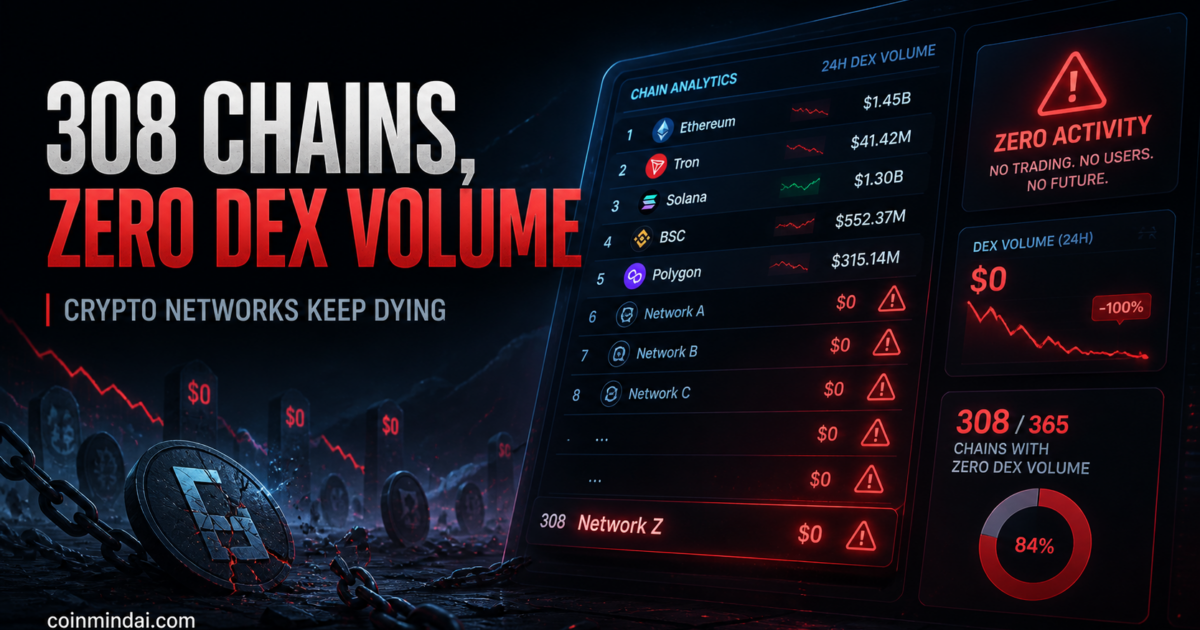
The crypto market may be entering a painful but necessary reset, as fresh DeFiLlama data shows that hundreds of blockchain networks are failing to generate meaningful on-chain trading activity.
According to current data reviewed on DeFiLlama’s chain rankings, 308 blockchain networks recorded zero DEX volume over the last 24 hours. The figure highlights a growing problem across the industry: while new chains continue to appear, many of them are struggling to attract real users, liquidity, applications, and sustainable economic activity.
The data comes at a time when the broader crypto market is still trying to separate strong ecosystems from speculative narratives. For investors, builders, and users, the message is becoming clearer: launching a blockchain is no longer enough. Networks now need real demand, active developers, liquidity depth, and applications that solve actual user problems.
Hundreds of Chains Show No DEX Activity
DEX volume is one of the most direct indicators of on-chain demand. When users trade assets through decentralized exchanges, it usually reflects liquidity, token activity, and ecosystem participation. However, when a network records no DEX volume at all, it may suggest that the chain has little to no active DeFi usage during that period.
DeFiLlama’s chain dashboard allows users to sort networks by metrics such as total value locked, stablecoin market capitalization, DEX volume, and chain fees. When sorted by 24-hour DEX volume, a large number of networks show no trading activity, while only a smaller group of chains continue to capture meaningful liquidity and user attention.
This does not always mean that every inactive chain is permanently dead. Some networks may be early, experimental, specialized, or temporarily inactive. Still, the scale of low-activity chains points to a deeper structural issue across crypto: the market has created more infrastructure than users currently need.
Why Are So Many Blockchain Networks Losing Activity?
During previous crypto cycles, launching a new Layer 1 or Layer 2 network was often enough to generate excitement. New ecosystems attracted capital through token incentives, airdrop expectations, grants, and speculative trading. But the market has changed.
Today, users are more selective. Liquidity is concentrated on stronger ecosystems such as Ethereum, Solana, Base, BNB Chain, Arbitrum, and a handful of other active networks. Meanwhile, smaller chains often struggle to retain developers and users once initial incentives fade.
There are several reasons behind this decline:
- Too many networks were launched without clear demand.
- Many ecosystems relied heavily on incentives instead of organic usage.
- Users prefer chains with deeper liquidity and better applications.
- Developers are focusing on ecosystems where users already exist.
- Speculative hype is no longer enough to sustain long-term activity.
This shift is especially important for the altcoin market, where many tokens are directly tied to the success of their underlying networks. If a blockchain cannot generate real usage, its native token may face long-term pressure regardless of short-term price movements.
The Crypto Market Is Entering a Natural Elimination Phase
The current data suggests that crypto may be going through a natural elimination phase. In earlier cycles, the market rewarded expansion. New chains, new tokens, new narratives, and new ecosystems were often priced aggressively before they proved real adoption.
Now, the market appears to be asking a harder question: which networks actually matter?
This reset may look negative in the short term, but it could be healthy for the industry over time. Weak projects, unused networks, and artificial ecosystems may gradually disappear, allowing capital and users to flow toward stronger infrastructure. In the long run, this could make the crypto market more efficient and easier to evaluate.
For readers following broader market conditions, CoinMindAI’s crypto market analysis section tracks the key trends shaping Bitcoin, altcoins, liquidity, and investor sentiment.
DEX Volume Is Becoming a Key Survival Metric
In the current environment, DEX volume has become more than just a trading statistic. It is increasingly viewed as a survival metric for blockchain ecosystems.
A chain with consistent DEX volume usually has at least some combination of active users, liquidity providers, DeFi protocols, token markets, and developer interest. By contrast, a chain with zero or near-zero DEX volume may struggle to prove that it has an active economy.
This is why investors should be careful when evaluating small-cap blockchain projects. A low market cap alone does not make a project undervalued. If the network has no liquidity, no DEX activity, no fees, and no real user base, the risk can be significantly higher.
Not Every Inactive Chain Is Finished, But the Warning Is Clear
It is important to avoid labeling every low-volume network as a failed project. Some chains may be focused on infrastructure, gaming, enterprise use cases, Bitcoin scaling, app-specific environments, or early-stage ecosystem development. Others may still be waiting for major applications to launch.
However, the broader warning remains clear. In a competitive market, chains that cannot attract users, liquidity, and developers may continue to fade. The next phase of crypto is likely to reward networks that deliver real utility rather than those that only rely on branding, token launches, or short-term incentives.
The industry has seen this pattern before. During every major cycle, thousands of projects emerge, but only a smaller number survive. This time, the same process appears to be happening at the blockchain network level.
What Comes Next for Crypto Networks?
The decline in activity across hundreds of chains may continue as liquidity becomes more concentrated. Stronger networks could benefit from this trend as users migrate toward ecosystems with better applications, lower friction, deeper liquidity, and stronger developer communities.
At the same time, the elimination of weak networks may eventually create room for a new wave of innovation. Once unnecessary infrastructure is cleared out, the market may become more focused on chains that offer real improvements in scalability, user experience, asset tokenization, payments, decentralized trading, and consumer applications.
For now, the data sends a simple message: crypto is no longer impressed by new chains alone. The market wants proof of usage.
Bottom Line
The fact that 308 blockchain networks recorded no DEX volume in the last 24 hours is a strong reminder that the crypto market is becoming more selective. Many networks that once promised growth are now struggling to show real activity.
This reset may be uncomfortable, but it could also be necessary. As weak ecosystems disappear, stronger networks and genuinely useful projects may gain more attention over time. For investors, the key lesson is clear: in the next phase of crypto, real activity may matter more than hype.
Not Financial Advice: This article is for informational purposes only and should not be considered investment advice. Always conduct your own research before making financial decisions.
This article was first published on CoinMindAI.com.