

BlockDAG (BDAG) is one of the more heavily discussed emerging Layer 1 crypto projects, largely because it combines a Proof-of-Work model, DAG-based architecture, and EVM compatibility. According to the project’s official materials, BlockDAG positions itself as a Bitcoin-inspired network designed for higher throughput and broader smart contract utility, while its development updates say mainnet block production went live on February 10, 2026.
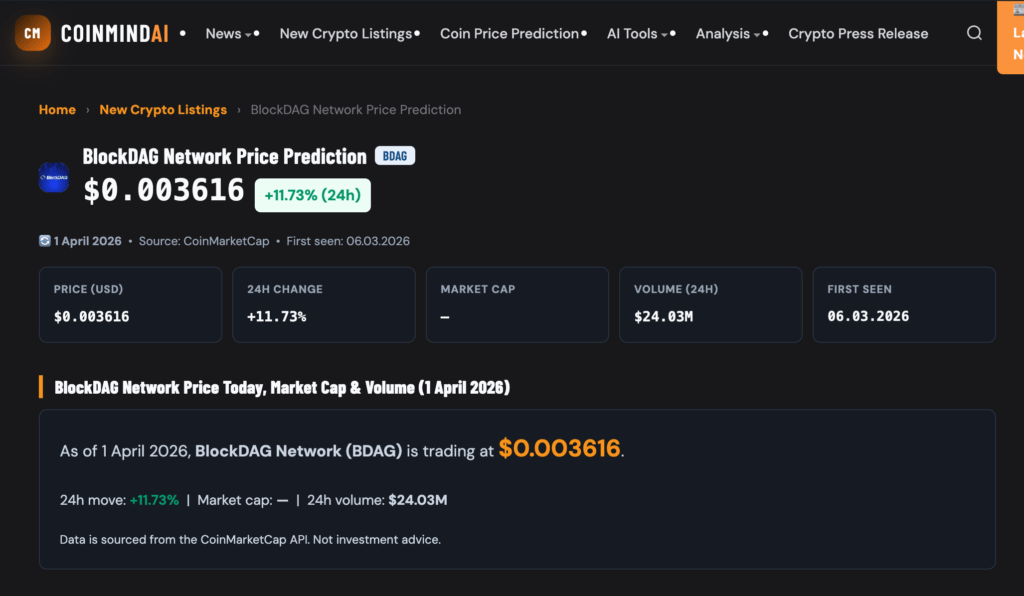
At the time of writing, the figures provided for BDAG show a price of $0.003393, a market cap of $95.75 million, 24-hour volume of $24.01 million, a self-reported circulating supply of 27.84 billion BDAG, a total supply of 100.41 billion, and a maximum supply of 150 billion BDAG. CoinMarketCap also shows a relatively high 24-hour volume-to-market-cap ratio, which usually points to elevated volatility and fast-moving speculative activity rather than stable price discovery.
That matters because BDAG is not being valued like a mature Layer 1 yet. Instead, the token still looks like a high-risk market that is trying to transition from hype, launch expectations, and ecosystem promises into sustained on-chain usage and exchange liquidity. For traders and long-term holders alike, the key question is simple: can BlockDAG turn its technical narrative into durable demand?
What Is BlockDAG?
BlockDAG markets itself as a Layer 1 network that blends a Directed Acyclic Graph structure with Proof-of-Work security. The project also states that it is fully EVM compatible, which means Ethereum-style applications and Solidity-based smart contracts can theoretically be migrated or deployed more easily on the network. Official development materials also mention parallel block processing and cite around 2,000 TPS at launch as part of its roadmap.
From an investment analysis perspective, this gives BDAG three core narratives:
- Bitcoin-style security branding through PoW
- Scalability branding through DAG architecture
- Developer adoption potential through EVM compatibility
That combination is attractive on paper. However, crypto markets usually demand more than architecture claims. Over time, valuation tends to depend on whether a chain can build real user activity, liquidity depth, application growth, and retention.
Why Is BDAG Price Down Today?
A one-day drop in BDAG does not necessarily mean the project has fundamentally changed. In many smaller-cap tokens, daily weakness is often driven by a mix of:
- short-term profit taking,
- thin order books,
- speculative volume,
- supply concerns,
- and uncertainty around post-launch ecosystem traction.
In BDAG’s case, the token still carries a fairly large supply profile. Official tokenomics show a 150 billion max supply, with major allocations going to miners, presale, community/ecosystem, liquidity, and team reserves. That kind of supply structure means the market will continue to watch unlocks, emissions, exchange liquidity, and demand growth very closely.
There is also a perception factor. When a project has spent a long time building anticipation, markets often expect quick traction after launch milestones. If real usage grows slower than expected, price can drift lower even when development is still active.
BlockDAG Tokenomics: Why Supply Matters
One of the biggest factors in any BDAG price prediction is token supply.
According to BlockDAG’s official tokenomics, the maximum supply is 150 billion BDAG. The allocation is broken down into 75 billion for miners, 50 billion for presale, 19 billion for community and ecosystem, 4.5 billion for liquidity, and 1.5 billion for the team.
This is important because even low nominal prices can imply large valuations when supply is high.
For example:
- At $0.005, BDAG’s circulating market cap would be roughly $139.2 million.
- At $0.01, the circulating market cap would be roughly $278.4 million, while the fully diluted valuation at that same price would be about $1.5 billion.
- At $0.02, the circulating market cap would be roughly $556.8 million.
So while a move from $0.003393 to $0.01 may sound small in dollar terms, it would still represent a major re-rating by the market.
BlockDAG (BDAG) Price Prediction 2026
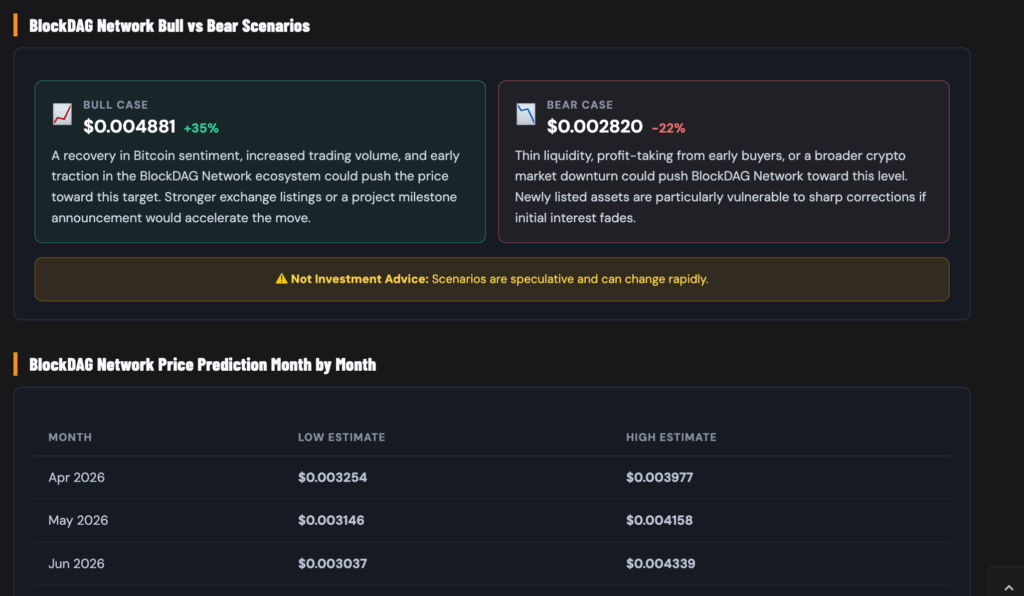
Bearish Scenario: $0.0020 to $0.0030
If crypto market sentiment weakens further and BlockDAG struggles to show meaningful user adoption, BDAG could remain under pressure. In this case, the token may continue trading near its current lower range, especially if traders focus more on supply overhang than ecosystem growth.
Base Scenario: $0.0045 to $0.0075
This is the more balanced scenario. If BlockDAG keeps building after its mainnet activation, secures broader exchange activity, and improves liquidity, BDAG could recover above current levels without needing extreme hype. This range would imply modest confidence returning to the project, but not full market conviction.
Bullish Scenario: $0.01 to $0.02
For BDAG to move into this range, the project would likely need stronger catalysts: growing on-chain activity, deeper exchange support, credible dApp traction, or a broader altcoin rally. A $0.01 BDAG price would already imply a substantially higher valuation than current levels, so this is possible, but it would require execution rather than narrative alone.
Can BlockDAG Reach $1?
Realistically, $1 is an extremely ambitious target.
Why? Because with a 150 billion max supply, a $1 BDAG price would imply a fully diluted valuation of roughly $150 billion. Even using the current self-reported circulating supply of 27.84 billion, a $1 price would imply a circulating market cap near $27.84 billion. That would place BlockDAG among the largest crypto assets in the world. Based on the current size of the project and its present market metrics, that looks far beyond the near-term picture.
That does not mean BDAG cannot rise. It means investors should separate realistic upside targets from headline-driven moonshot claims.
Is BlockDAG a Good Investment?
That depends on risk tolerance.
The bullish case is clear:
- the project has an active brand,
- a live market presence,
- official mainnet progress,
- EVM compatibility,
- and a differentiated mix of PoW plus DAG positioning.
The bearish case is just as clear:
- supply is large,
- valuation can expand quickly even at low prices,
- execution risk remains high,
- and competition among Layer 1 networks is intense.
In simple terms, BDAG looks more like a high-risk speculative Layer 1 bet than a proven blue-chip crypto asset.
Frequently Asked Questions About BlockDAG (BDAG)
What is BlockDAG?
BlockDAG is a Layer 1 blockchain project that combines DAG-based transaction architecture, Proof-of-Work consensus, and EVM compatibility, according to its official materials.
Is BlockDAG mainnet live?
BlockDAG’s official development updates say mainnet block production was activated on February 10, 2026.
What is the maximum supply of BDAG?
The official tokenomics page lists a maximum supply of 150 billion BDAG.
Can BlockDAG reach 1 cent?
Yes, $0.01 is more realistic than $1, but it would still require a significant increase in market value, liquidity, and adoption. At $0.01, the circulating market cap would be about $278.4 million, and the FDV would be roughly $1.5 billion.
Can BlockDAG reach $1?
It is theoretically possible in markets, but based on current supply and valuation math, it looks highly unrealistic in the near term.
How do you buy BDAG?
BlockDAG’s official buying guide says users can purchase using supported crypto such as ETH, BNB, or USDT, and the mainnet page also references confirmed exchange listings including MEXC, LBank, Coinstore, BitMart, and XT, along with additional listings claimed by the project.
Is BlockDAG mineable?
Yes. The project officially promotes both its mining ecosystem and its X1 mobile mining app, while its development updates also reference live mining consensus with ASIC participation.
Final Thoughts
BlockDAG is one of those crypto projects where the story is still being written. It has enough technical ambition and branding to stay on the radar, but the market is clearly asking for proof of long-term execution. For now, BDAG looks like a token that could rebound if adoption, liquidity, and ecosystem activity improve — but it also remains vulnerable to volatility, supply pressure, and changing sentiment.
For 2026, the most realistic outlook is not whether BDAG can reach $1, but whether it can hold support, reclaim momentum, and eventually challenge the $0.01 level with real utility behind it.
Disclaimer: This article is for informational and educational purposes only and does not constitute investment advice, financial advice, or a recommendation to buy or sell any asset.