

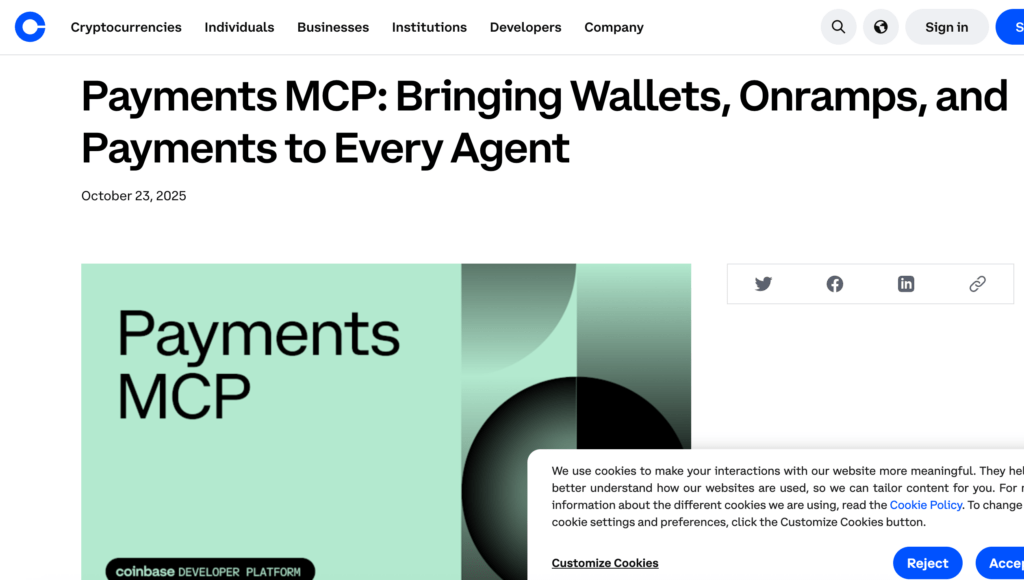
In October 2025, Coinbase quietly launched something that most retail investors completely overlooked. A tool called Payments MCP and what it does is almost unsettling if you think about it long enough.
For the first time, an AI language model like Claude or Gemini can create its own crypto wallet, load it with funds, and execute real on-chain transactions. No human clicking “confirm.” No one double-checking the address. Just an AI, a prompt, and actual money moving on a blockchain.
Coinbase’s head of engineering described it plainly: “Crypto is uniquely suited to machines. It is the only open, digital-native standard for payment that any program can use.”
That moment marked a genuine turning point. The question that millions of crypto investors are now quietly searching for can an AI actually trade on my behalf? finally has a real, complicated, and important answer.
First, Let’s Separate the Two Very Different Things People Mean
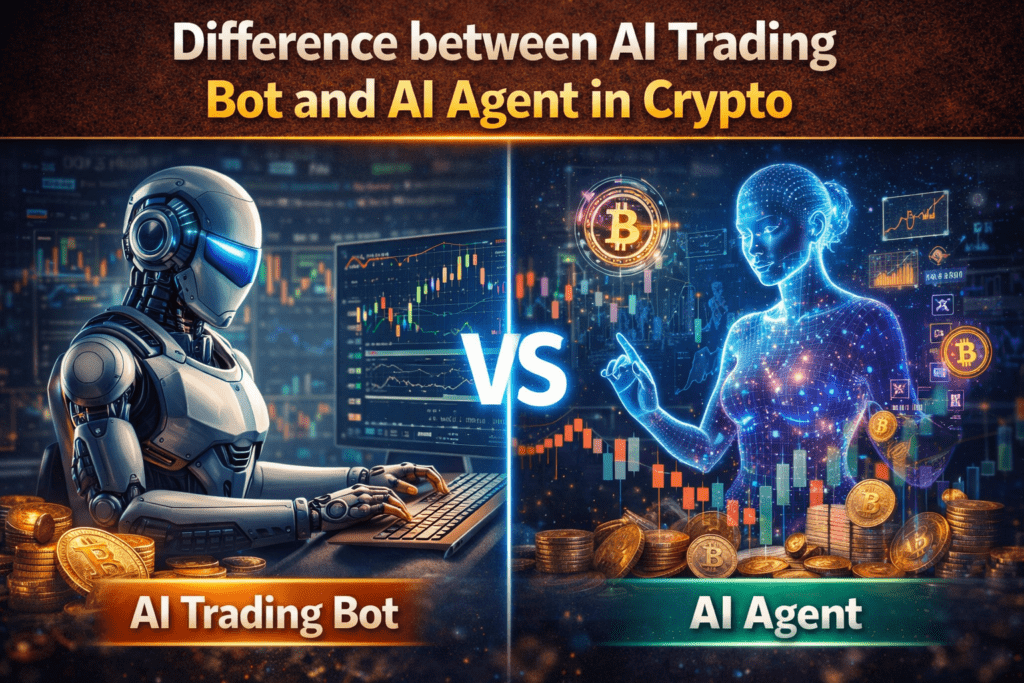
When someone types “AI crypto trading” into Google, they’re usually asking about one of two completely different things. Mixing them up is how people get burned.
Thing #1: AI Trading Bots
These have existed for years. Platforms like 3Commas, Cryptohopper, and dozens of others offer bots that follow pre-programmed rules buy when RSI drops below 30, sell when price hits a target, grid trade between two price levels. Some of these now layer in machine learning to adapt their rules over time. But the core mechanic is the same: you set up the strategy, you give it API access to your exchange account, and it executes trades while you sleep.
Thing #2: Autonomous AI Agents
This is newer, stranger, and far more significant. An AI agent doesn’t just follow rules you wrote. It reasons, plans, and acts toward a goal you describe in plain language. With tools like Coinbase’s Payments MCP, an agent can now manage a crypto wallet end-to-end receiving funds, making payments, and interacting with DeFi protocols without a human approving each step.
Most of the internet’s existing content on this topic blurs these two categories together. That’s exactly why people end up confused and, in the worst cases, trusting the wrong thing with real money.
How AI Trading Bots Actually Work (And Where They Fall Short)
A bot doesn’t think. That’s the most important thing to internalize before you give one access to your exchange account.
What it does is pattern recognition at machine speed. It can scan thousands of price data points per second, monitor dozens of indicators simultaneously, and execute an order in milliseconds something no human can physically match. In markets where speed and consistency matter, those capabilities are genuinely valuable.
The best-performing documented case in 2025 was a bot using AI-optimized dollar-cost averaging with leveraged positions that achieved a 193% return over six months. That’s a real result. It’s also, notably, the headline number. Most bots don’t do that.
What bots are good at:
- Executing strategies without emotional interference (no panic selling, no FOMO buying)
- Running 24/7 across multiple pairs simultaneously
- Backtesting hundreds of strategy variations quickly
- Reacting to market moves faster than any human
What bots are bad at:
- Understanding why something is happening. A bot can’t read a regulatory announcement, assess a team’s credibility, or smell a rug pull coming. It sees price and volume. That’s mostly it.
- Adapting to genuinely novel market conditions. When something happens that has no historical precedent, a bot trained on historical data has no reference point.
- Protecting you if the software itself is compromised. Hackers actively target AI trading bots because they require API key access to your exchange account. If the bot platform gets hacked, so does your portfolio.
One more thing worth saying plainly: the CFTC has warned investors explicitly that fraudsters routinely use AI as a marketing hook to promise guaranteed or outsized returns. If a bot is promising 100% win rates or “AI that can predict the market,” you’re being sold something that doesn’t exist.
The New Thing: AI Agents That Actually Hold Your Crypto
Now for the genuinely new development the one that didn’t exist two years ago.
In September 2025, Coinbase launched Payments MCP, built on top of their open payment protocol called x402. The name is a reference to an old HTTP status code “402: Payment Required” that was technically defined in 1991 but never implemented because no internet-native payment standard existed. Coinbase is trying to make that finally happen, except for AI.
Here’s what Payments MCP actually allows:
- An AI agent can create a crypto wallet with nothing more than an email address. No developer setup, no API keys.
- It can receive and hold stablecoins (primarily USDC) in that wallet.
- It can send payments on-chain, paying for APIs, data services, or anything else that accepts x402 payments.
- Users set spending limits so the agent can’t drain more than a defined amount without approval.
The initial release works with Claude (Anthropic), Gemini (Google), and OpenAI’s Codex. ChatGPT is not supported yet due to technical incompatibilities with how OpenAI’s streaming system currently works.
By early 2026, Coinbase went a step further and announced dedicated crypto wallet infrastructure specifically designed for AI agents. The vision Coinbase’s engineering team is describing — where AI agents autonomously buy compute, data, and services using stablecoins is now being called the “year of agentic payments.”
Most people won’t even see the crypto when this goes mainstream. As one Coinbase engineer put it: “They will see an AI balance go down five dollars, and the payment settles instantly with stablecoins behind the scenes.”
The Real Question: Should You Let an AI Agent Trade For You?
Here’s an honest answer, because most of what’s published on this topic isn’t.
For fully autonomous trading of your portfolio: not yet, and probably not for a while.
The infrastructure for agents to hold wallets and make payments is real and functional. What doesn’t yet exist at a consumer level is an AI agent that can reliably navigate the full complexity of crypto markets assessing fundamentals, reading sentiment, detecting manipulation, managing risk across an actual portfolio with the kind of judgment that protecting your money requires.
The best traders in 2025, including the ones using the most sophisticated AI tools, are using AI alongside their own analysis not as a replacement for it.
What AI genuinely helps with right now:
Sentiment Analysis. Before making any move, understanding whether the market is running on fear or greed changes everything. Our Crypto Sentiment Analyzer scans real-time signals across markets and social data so you’re not flying blind on market mood.
Rug Pull Detection. The single most dangerous thing about newer tokens isn’t price volatility — it’s the risk of the project disappearing with your money. Our Rug Pull Checker uses AI to analyze contract code, liquidity patterns, and team behavior before you put a dollar in.
Whale Monitoring. When wallets holding tens of millions of dollars start moving, the market usually follows. Whale Watch tracks large wallet movements in real time, giving retail investors a signal that used to be available only to well-connected insiders.
Fear & Greed Indexing. One of the most reliable contrarian signals in crypto is the Fear & Greed Index. When it’s deep in fear territory, historically it’s been a buying opportunity. When it’s maxing out greed, caution is warranted. Check our live Fear and Greed Index before any significant position.
These tools don’t trade for you. That’s the point. They make you better at the decisions that matter.
The Security Layer You Cannot Ignore
Whether you’re using a traditional trading bot or experimenting with AI agents, the security fundamentals are the same and they’re non-negotiable.
For trading bots:
- Never give an API key withdrawal permissions. A trading bot needs to read your balance and place orders. It does not need to withdraw funds. That permission is how people lose everything.
- Use exchange-level IP whitelisting so the API key only works from your specific IP.
- Rotate your API keys every 30–60 days.
- Never install bot software downloaded from unofficial sources.
For AI agents:
- Set strict spending limits before giving an agent wallet access.
- Use a dedicated, isolated wallet funded only with what you’re comfortable losing if something goes wrong.
- Review agent transaction history regularly the same way you’d review a bank statement.
- Be extremely skeptical of any third-party tool claiming to be an “AI agent” that asks for your seed phrase or private key. No legitimate agent infrastructure requires this.
What’s Actually Coming Next
The infrastructure being built in 2026 suggests AI’s role in crypto will expand significantly, but probably not in the dramatic “AI managing your whole portfolio” way that gets clicks.
More likely: AI agents will handle the boring, repetitive, and fast-moving tasks executing a DCA order at the exact right price, rebalancing a portfolio toward a preset allocation, paying for on-chain data services automatically. The judgment calls which assets to hold, how much risk to take, when to exit a position entirely — those will stay with humans for a meaningful period.
Coinbase and Cloudflare are jointly building the x402 Foundation as an open, neutral standard for agent payments. When that standard matures and other exchanges and DeFi protocols adopt it, the picture will change again.
The smartest move right now is to understand how these tools work before everyone else does and to use AI to sharpen your own decision-making, rather than waiting for a system that can replace it.
The Short Version
Did an AI quietly gain the ability to hold a crypto wallet and transact on-chain without human approval? Yes, as of late 2025, that’s real.
Should you hand your portfolio over to an AI agent and walk away? No. Not yet, and only with strict controls even if you do experiment.
Is AI already genuinely useful for crypto investors right now? Absolutely for analysis, risk detection, sentiment reading, and market signal tracking.
The gap between “AI can help you trade better” and “AI trades for you” is still wide. The investors who understand where that line actually sits will be in a much better position than those who either dismiss AI entirely or trust it blindly.
Frequently Asked Questions
What is an AI crypto agent?
An AI crypto agent is a software program that can reason, plan, and take actions in crypto markets autonomously — without a human approving each step. Unlike traditional trading bots that follow fixed rules, AI agents use large language models to interpret goals, make decisions, and in some cases manage a real crypto wallet end-to-end. Coinbase’s Payments MCP, launched in late 2025, was a landmark moment that gave AI agents the ability to hold and transact with actual funds on-chain.
Can AI trade crypto on your behalf?
Yes, technically — but with important caveats. AI trading bots have been executing rule-based trades for years. Autonomous AI agents that independently manage a full portfolio are newer and still carry significant risks. Most serious crypto traders in 2025 use AI as a decision-support tool rather than a fully autonomous trader. Handing over complete control to any automated system without spending limits and regular oversight is not recommended at this stage.
Are AI trading bots the same as AI agents?
No, they are fundamentally different. An AI trading bot executes a strategy you pre-define — buy when RSI drops below 30, sell at a price target. It doesn’t think; it executes. An AI agent reasons toward a goal you describe in plain language and decides how to act on its own. The distinction matters because the risks, trust requirements, and appropriate use cases are completely different for each.
Is it safe to let AI manage a crypto wallet?
It can be done relatively safely if you follow strict controls: use a dedicated isolated wallet, set hard spending limits, never grant withdrawal permissions to bots via API, and review transaction history regularly. What is never safe is handing any AI system your seed phrase or private key — no legitimate AI agent infrastructure requires this. If a tool asks for it, it is a scam.
What are the risks of autonomous crypto agents?
The main risks are: smart contract vulnerabilities if the agent interacts with DeFi protocols, hacking of the agent platform itself giving attackers API access to your funds, bugs in the agent’s decision logic leading to unintended trades, and the agent’s inability to interpret qualitative events like regulatory news or team controversies that aren’t reflected in price data yet. These risks don’t make agents unusable — they make careful setup and spending limits non-negotiable.
Disclaimer: This article is for informational purposes only and does not constitute financial or investment advice. Crypto assets carry significant risk. Always conduct your own research.