
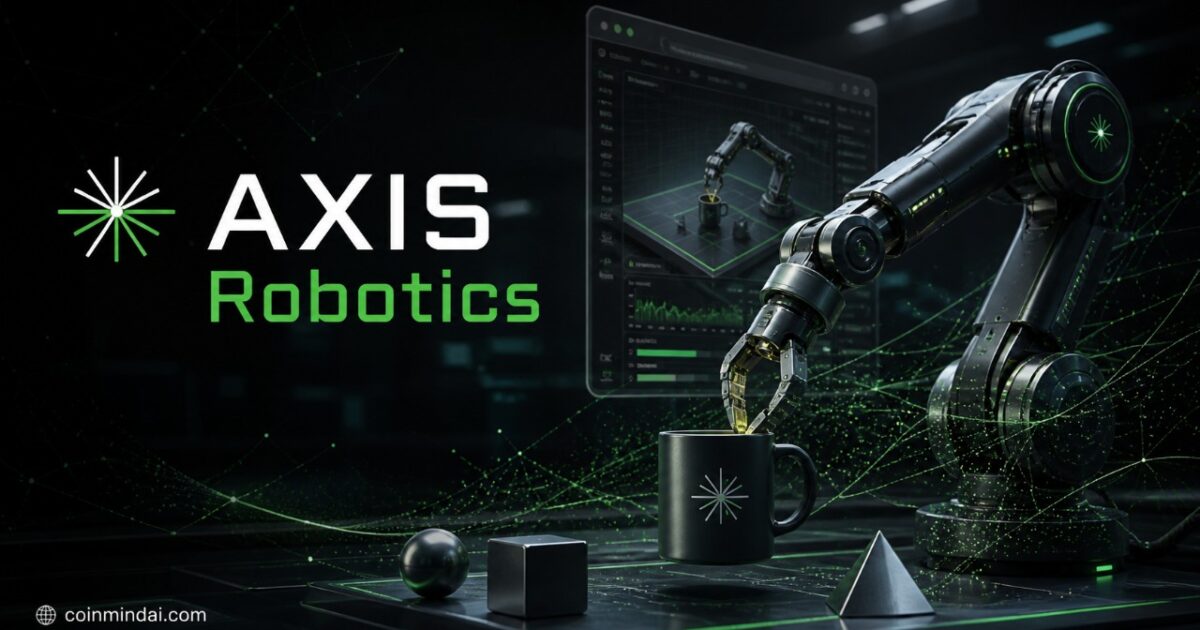
AXIS Robotics is emerging as one of the most interesting projects in the growing Physical AI sector. As artificial intelligence moves beyond text, images, and software, the next major step is teaching machines how to understand and interact with the real world. This is where browser based robot training, robotics simulation, AI data generation, and on-chain contribution systems begin to matter.
The project has attracted attention because it combines several powerful narratives at the same time: Physical AI, robotics infrastructure, simulation based training, crypto incentives, Base network data recording, and possible future TGE expectations. For users following early AI and Web3 trends, AXIS Robotics is becoming a project worth watching closely.
AXIS Robotics has reportedly raised $5 million from investment firms including GSR, Galaxy, and KuCoin-related investors. This funding has increased interest around the project, especially among users looking for early infrastructure plays in the AI and robotics market.
AXIS Robotics Funding and Why It Matters
The reported $5 million funding round is important because robotics is facing a major data problem. Large language models became powerful because they were trained on massive amounts of internet data. Text, code, articles, books, forums, and websites created a huge training layer for AI models.
Robots do not have the same advantage.
There is no giant public database of robotic movement. There is no complete internet archive of how robot arms pick up mugs, open drawers, sort objects, or move through real environments. For robots to become more intelligent, they need high-quality physical interaction data.
That is the problem AXIS Robotics is trying to solve. Instead of relying only on expensive robotics labs, the project allows users to generate robotic training data through browser-based simulation.
This makes AXIS Robotics interesting not only for AI users, but also for crypto users who follow early contributor-based ecosystems. Readers who want to follow similar early stage Web3 and AI developments can also check CoinMindAI’s crypto news section for broader market updates.
AXIS Robotics TGE: Is There a Token Launch?
At the time of writing, AXIS Robotics has not confirmed a public TGE date. However, because the project includes contributor activity, Data IDs, on-chain verification, and crypto-based infrastructure, many users are watching it as a possible early ecosystem opportunity.
This does not mean a token launch is guaranteed. It also does not mean every user activity will automatically lead to rewards. In early crypto projects, users should always separate confirmed information from speculation.
Still, the structure of AXIS Robotics makes early participation interesting. If a project is building a distributed data network, then quality contributions, accepted data, and user activity may become important over time.
For readers who are new to this type of early participation model, CoinMindAI’s crypto airdrop guide explains how contribution-based ecosystems and early activity sometimes work in Web3.
What Is AXIS Robotics?
AXIS Robotics is a Physical AI infrastructure project focused on robotic training data. In simple terms, it allows users to control simulated robots from a browser and generate data that can help train future robotic systems.
Users do not need a real robot, expensive equipment, or access to a robotics lab. They can enter a simulation, control a robotic arm, and complete simple tasks such as picking up a mug, moving objects, sorting items, or opening a drawer.
While the user performs these actions, the system records the movement as data. This data can later be cleaned, replayed, expanded, and used to improve robotic AI models.
The main idea is simple: make robot training data easier to create, scale, and verify.
How AXIS Robotics Works
AXIS Robotics uses a simulation-first model. A user enters a browser-based simulator and controls a robotic arm. Every action during the task can be recorded as a trajectory.
A trajectory is a full record of how a robot completes a task from start to finish. It may include robot joint movements, object positions, control actions, task details, timing data, and other simulation information.
For example, if a user controls a robot arm to pick up a mug, AXIS Robotics can record how the arm moved, where the mug was located, what actions were taken, and whether the task was completed successfully.
That recorded session becomes useful training data.
The data can then be processed and expanded in more advanced simulation environments. One simple action can be replayed under different lighting conditions, object positions, textures, camera angles, and physics settings.
This helps robotic AI models learn general behavior instead of memorizing only one specific environment.
Why Physical AI Needs Better Data
Physical AI is different from normal software based AI. A chatbot can learn from text. An image model can learn from pictures. But a robot needs to understand movement, space, force, objects, and real-world interaction.
This makes robotic intelligence much harder to build.
A robot must understand how to grip an object, how much pressure to apply, how to avoid obstacles, and how to complete a task when the environment changes. Even a simple action like picking up a cup can become difficult if the cup shape, table height, camera angle, or lighting changes.
This is why robotic data is so valuable.
Real-world robot data is expensive to collect because it requires hardware, sensors, operators, controlled spaces, maintenance, and safety systems. AXIS Robotics tries to reduce this barrier by moving the first layer of robot training into simulation.
Why Simulation Matters in Robotics
Simulation allows robots to practice in digital environments before being tested in the real world. This reduces cost, risk, and hardware limitations.
In real-world training, robots can break objects, damage equipment, or fail repeatedly. In simulation, tasks can be repeated, adjusted, and expanded more easily.
AXIS Robotics treats simulation as the starting point for robotic data generation. The platform allows users to complete simulated tasks, then turns those actions into structured data that can support future robot learning.
The goal is not only to teach a robot one specific action. The goal is to help robots learn the logic of physical interaction across many different environments.
Why AXIS Robotics Uses Blockchain
Blockchain is not the main product of AXIS Robotics. The main focus is robotic data infrastructure. However, blockchain can help the system in several important ways.
First, blockchain can support transparent contribution records. AXIS Robotics says accepted trajectories can receive a unique Data ID and be recorded on the Base network.
Second, blockchain can help with data provenance. As AI training data becomes more important, knowing where data came from and who contributed it may become valuable.
Third, crypto-based systems can help align incentives. If users contribute useful data, a network can potentially reward quality contributions rather than only rewarding activity volume.
This is why AXIS Robotics is being watched by both AI users and crypto users.
AXIS Robotics and the Base Network
One of the notable parts of AXIS Robotics is its use of Base for recording accepted data. When a user submits a successful trajectory, that data can be connected to a unique Data ID.
This creates a more transparent link between the contributor and the data. In the future, this type of provenance could become important for enterprises, AI developers, and robotics companies that want to understand how training data was created.
For users who are still learning how blockchain records and decentralized systems work, CoinMindAI’s crypto learning hub offers beginner-friendly educational content on core crypto concepts.
What Makes AXIS Robotics Different?
AXIS Robotics is different because it lowers the barrier to robot training. Most people cannot buy a robotic arm. Most users do not have access to robotics labs. Most people cannot collect real robotic data at scale.
AXIS Robotics makes participation easier by moving robot training into the browser.
This means users can contribute without owning hardware. They are not directly building robots. They are completing simulated tasks that can become useful robotic training data.
If this model scales, AXIS Robotics could help create a large distributed dataset for Physical AI.
Potential Use Cases of AXIS Robotics
Robotic Manipulation
Robotic arms need to learn how to pick, place, push, pull, rotate, and sort objects. AXIS Robotics can help generate many examples of these actions through simulation.
Warehouse Automation
Warehouses need robots that can interact with boxes, shelves, packages, and tools. Simulation-based training data may help robots adapt to different layouts and object types.
Home Robotics
Future home robots may need to open drawers, move cups, clean surfaces, and handle daily objects. These actions require diverse training examples.
Industrial Robotics
Factories already use robots, but many systems are limited to repetitive tasks. More flexible industrial robots need better generalization, and simulation data can support that goal.
Vision-Language-Action Models
Modern robotics AI may rely on Vision-Language-Action models. These models connect visual understanding, instructions, and physical movement. AXIS Robotics could help generate the action data needed for this type of training.
Why AXIS Robotics Could Become Important
The biggest reason AXIS Robotics matters is simple: robots need data.
AI has already become powerful in digital environments. The next challenge is bringing that intelligence into the physical world. For that to happen, robots need more examples of how to interact with objects, spaces, and changing environments.
AXIS Robotics is trying to create a scalable data layer for this future.
If the project succeeds, it could become part of a broader Physical AI infrastructure market where robotic data, simulation, contributor networks, and on-chain verification work together.
This is why AXIS Robotics is worth watching as an early AI and robotics project.
Risks and Things to Watch
AXIS Robotics is still an early-stage project, so users should be careful. The idea is interesting, but long-term success will depend on execution, product quality, contributor growth, data usefulness, enterprise demand, and real-world robotic performance.
Users should also watch for official updates about partnerships, reward mechanics, product development, funding details, and TGE plans.
As with any early crypto-related project, users should verify official links, avoid fake websites, and never connect wallets to suspicious platforms. CoinMindAI’s rug pull checker tools guide can help users understand basic safety checks before interacting with unknown crypto platforms.
AXIS Robotics and the Future of AI, Robotics and Crypto
AXIS Robotics represents a broader market trend. AI is moving from digital intelligence to physical intelligence. Robotics is becoming a key part of that transition. Crypto can add coordination, contribution tracking, ownership records, and incentive systems.
This combination is still early, but it could become one of the strongest narratives in the coming years.
Projects like AXIS Robotics are important because they are not only creating another token story. They are trying to solve a real infrastructure problem: how to generate enough useful data for robots to become smarter.
For readers following the larger market cycle around AI and crypto, CoinMindAI’s Crypto Fear and Greed Index can help track whether investors are currently leaning toward risk-on or risk-off behavior.
Conclusion
AXIS Robotics is building browser-based infrastructure for Physical AI. The project allows users to control simulated robotic arms, complete physical tasks, and generate movement data that may help train future robots.
Its reported funding, simulation-first model, Base network data recording, and possible future TGE expectations have made it an interesting project for users following AI, robotics, and crypto infrastructure.
However, AXIS Robotics should still be treated as an early-stage project. There is no confirmed public TGE date at the time of writing, and users should follow official announcements for accurate updates.
The core idea is clear: if robots need better data to become smarter, AXIS Robotics wants to make that data easier to create, scale, and verify.
As Physical AI grows, projects focused on robotic data infrastructure could become increasingly important.
FAQ
What is AXIS Robotics?
AXIS Robotics is a Physical AI project that allows users to control simulated robots from a browser and generate training data for robotic intelligence.
Does AXIS Robotics require real robot hardware?
No. AXIS Robotics is browser-based, so users can participate through simulation without owning a real robot.
How does AXIS Robotics generate robot training data?
Users complete tasks in simulation. Their movements are recorded as trajectories, which can later be processed and used as training data for robotic AI models.
Has AXIS Robotics raised funding?
AXIS Robotics has reportedly raised $5 million from investors including GSR, Galaxy, and KuCoin-related investment groups.
Does AXIS Robotics have a TGE date?
There is no confirmed public TGE date at the time of writing. Users should follow official AXIS Robotics channels for updates.
Is AXIS Robotics an airdrop project?
AXIS Robotics is mainly a Physical AI and robotic data infrastructure project. However, because it includes contributor activity and on-chain verification, many users are watching it as a possible early ecosystem opportunity.
What is Physical AI?
Physical AI refers to artificial intelligence systems that can understand, move, and interact with the physical world through robots or autonomous machines.
Why does AXIS Robotics use Base?
AXIS Robotics says accepted data can receive a unique Data ID and be recorded on Base, helping create a verifiable record of contribution and provenance.
Why is AXIS Robotics important?
AXIS Robotics is important because it targets one of the biggest problems in robotics: the lack of scalable, high-quality training data.
Not Financial Advice: This article is for educational purposes only and should not be considered investment advice. Always do your own research before participating in any crypto, AI, or robotics-related project.