

If you have ever watched a crypto price spike violently in one direction and wondered what caused it, funding rates were likely part of the answer.
This metric sits quietly in the background of perpetual futures markets, but it tells you more about crowd positioning and squeeze risk than almost any other number available to retail traders.
What Is a Funding Rate in Crypto Perpetual Futures
A funding rate is a periodic payment exchanged between traders who hold long positions and those who hold short positions in a perpetual futures contract. It is not a fee paid to the exchange.
It is a balance mechanism paid directly between traders, usually every eight hours on most major platforms.
Perpetual futures never expire, which means there is no natural price convergence event like there is with traditional futures contracts. The funding rate is the mechanism that keeps the perpetual contract price anchored close to the spot price of the underlying asset.
When longs pay shorts, it discourages overleveraged long positions. When shorts pay longs, it discourages overleveraged short positions.
The rate itself is usually expressed as a percentage per eight hour period. A rate of 0.01 percent sounds small, but annualized it adds up quickly, especially for traders holding large leveraged positions over days or weeks.
How Funding Rates Work in Practice
When the perpetual futures price trades above the spot price, demand for longs is higher than demand for shorts. In this condition the funding rate turns positive, meaning long holders pay short holders.
This creates a direct financial incentive for traders to sell futures or open short positions, which pushes the futures price back toward spot.
When the perpetual price trades below spot, the opposite happens. The funding rate turns negative, meaning shorts pay longs.
This incentivizes closing shorts and opening longs, again nudging the price back into alignment.
The size of the rate reflects the intensity of the imbalance. A very high positive funding rate signals that long traders are paying a heavy premium to stay in their positions.
A deeply negative rate signals the same pressure on short traders. Either extreme creates a financial drain that forces some traders to close positions, which can accelerate rapid price moves in either direction.
Most exchanges calculate the funding rate using a combination of the interest rate component and the premium or discount between the futures price and the index price. Each platform has its own formula, but the directional signal is the same across all major venues.
Why Funding Rates Still Matter in Any Market Condition
Funding rates are one of the most real-time sentiment signals available in crypto. Unlike on-chain data that can lag by hours or days, the funding rate updates every few hours and reflects current market positioning with high accuracy.

During bull markets, persistently high positive funding rates warn that the market is becoming overcrowded on the long side. This setup historically precedes sharp corrections because overleveraged longs get liquidated when prices dip even slightly.
The cascade of liquidations amplifies the move far beyond what the initial price change would suggest.
During bear markets or periods of fear, deeply negative funding rates reveal the same crowding problem on the short side.
When too many traders are short and paying to maintain those positions, any positive catalyst can trigger a short squeeze that pushes prices dramatically higher even without a fundamental change in the asset.
Current context note: As perpetual futures volumes have grown substantially across both centralized and decentralized platforms in recent years, funding rate signals have become more widely followed and more actively traded. The same logic applies regardless of the specific market cycle.
Common Mistakes Traders Make When Reading Funding Rates
The biggest mistake is treating a high funding rate as a direct short signal. Funding rates can stay elevated for extended periods during strong trending markets.
Fading a high funding rate in a sustained uptrend has burned many experienced traders who assumed the rate alone was enough to justify a contrarian position.
A second common error is looking at funding rates in isolation. The rate becomes far more useful when combined with open interest data.
Rising open interest alongside a high positive funding rate means new money is entering leveraged long positions, which increases squeeze risk meaningfully. Falling open interest during the same condition suggests longs are being closed gradually, which is less alarming.
Traders also frequently ignore the compounding cost of holding a position through multiple funding periods. A rate of 0.05 percent per eight hours charged three times per day equals roughly 54 percent annualized.
Holding a leveraged long through a sideways market at those rates destroys capital even if the price never falls.
Finally, do not confuse negative funding with a bullish guarantee. Persistent negative funding in a bear trend can reflect rational positioning rather than an imminent squeeze.
Context around price structure, volume, and broader market sentiment all matter.
What Investors and Traders Should Monitor
Start by checking the funding rate for the asset you are watching on at least two major exchanges. Rates are not always identical across platforms, and significant divergence can itself be informative about localized positioning.
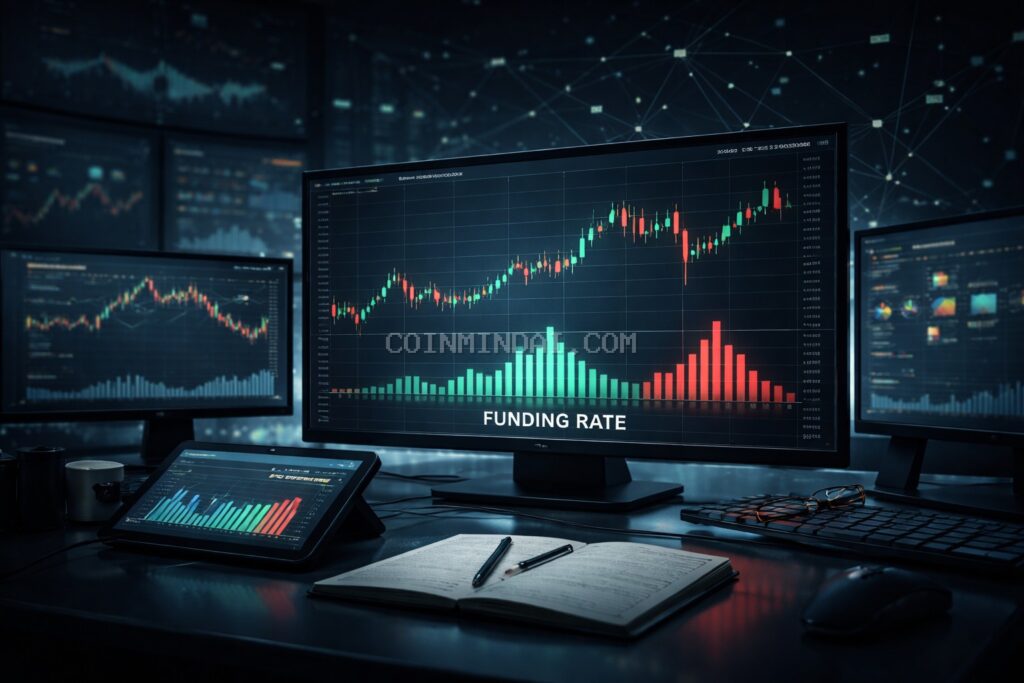
Watch for rate extremes rather than routine fluctuations. Rates that exceed 0.1 percent per eight hours or fall below negative 0.05 percent per eight hours have historically corresponded to periods of elevated squeeze risk in either direction.
These thresholds are not universal rules but useful reference points.
Combine funding rate data with open interest charts. You want to know not just whether the rate is high or low but whether leveraged exposure is increasing or decreasing at that level.
An aggregator view across multiple exchanges gives a cleaner read than any single platform.
Also track cumulative funding over time. Some dashboards display the cumulative funding paid or received over a rolling window of days or weeks.
A prolonged period of longs paying heavily into a sideways market sets up a different risk profile than a single spike in funding during a price breakout.
Data tracking: Funding rate data is available on most major exchange interfaces including Binance, Bybit, and OKX, which display live rates and historical charts directly on their futures trading dashboards. For aggregated cross-exchange views, Coinglass is widely used among derivatives traders and shows funding rates, open interest, and liquidation data in one place. TradingView also supports funding rate indicators through third party scripts. CoinGlass and Glassnode offer deeper historical analysis for researchers and long-term strategy review.
Frequently Asked Questions About Crypto Funding Rates
What does a high positive funding rate mean?
It means long traders are paying short traders to keep their positions open. The perpetual futures price is trading above spot, indicating that demand for leveraged long exposure is elevated.
This can signal crowding on the long side and increases the risk of a sharp downward correction if longs begin to unwind.
Can funding rates predict price direction?
Funding rates do not predict direction reliably on their own. They measure positioning imbalance rather than future price movement.
Extreme funding rates highlight elevated squeeze risk in one direction, but a squeeze requires a catalyst to occur. Treat funding as a risk signal, not a trade signal.
How often are funding rates paid out?
Most major exchanges settle funding every eight hours, which means payments occur three times per day. Some platforms use different intervals, including one-hour or four-hour funding cycles.
Always check the specific schedule for the exchange and contract you are trading because the cost structure varies.
What is the difference between funding rate and borrowing rate?
A funding rate is specific to perpetual futures and is exchanged between long and short traders as a price anchoring mechanism. A borrowing rate applies when you borrow assets on a spot or margin platform to open a leveraged position.
The two are separate costs that exist in different parts of the crypto trading infrastructure.
Bottom line: Funding rates are one of the clearest windows available into leveraged positioning and crowd sentiment in crypto perpetual futures markets. Understanding whether the market is paying longs or shorts, and by how much, helps investors recognize when squeeze risk is elevated and when leveraged exposure is becoming dangerously one-sided. No single metric tells the whole story, but funding rates belong in every crypto trader’s regular reading list.
Not Financial Advice: This article is for informational purposes only. Crypto assets carry significant risk. Always do your own research before making investment decisions.